Why I Stopped Lane Splitting on My Scooter (Even in KL Traffic)
When does lane splitting become too risky? After one too many near-misses in KL’s chaotic traffic, I hung up my lane-splitting habit for good. Here’s why – and what I do instead.
The Day I Decided to Stop
Lane splitting turns from a time-saver into an unnecessary gamble the moment a single close call makes you question whether shaving a few minutes off your commute is worth your safety. For me, that moment came on a humid Tuesday evening on Jalan Tun Razak.
I was threading through the usual kilometre-long crawl, my scooter’s mirrors folding in as I slipped between a packed RapidKL bus and a silver Myvi. The bus inched left without warning—no signal, just a lazy drift. My handlebar clipped the bus’s side mirror, sending my heart into my throat as I wobbled but didn’t go down. The Myvi’s driver honked, and for a split second, I was squeezed with nowhere to go except into the rear wheel of the bus. I somehow straightened up and ducked into a gap just wide enough for my scooter. As I pulled into the next petrol station to catch my breath, the decision made itself: I was done.
That near-miss wasn’t unusual in KL traffic—most of us have stories like it. But it forced me to ask: when does the daily gamble of lane splitting stop being a convenience and start being a habit you can’t afford to keep? The answer felt obvious, but the ride home that day was unusually quiet.
Why I Used to Love Lane Splitting
I used to see lane splitting as the main reason to ride a scooter in Kuala Lumpur. While cars sat motionless for hours, my scooter slipped through the narrowest gaps, turning a tedious trudge into a quick, almost enjoyable trip. The efficiency was undeniable—I arrived fresher and faster than any other mode of transport. Plus, there was a quiet thrill in using your machine's size to your advantage, as if scooters were designed specifically for this urban dance.
The Toll of Too Many Close Calls
It was never one dramatic crash that made me quit lane splitting. It was the steady, unnerving drumbeat of close calls that piled up until I could no longer ignore the math. When you thread through KL’s gridlock every day, you can almost convince yourself that each near miss is an isolated event—bad luck, a distracted driver, a moment of inattention. But after years on a scooter, those moments didn’t feel like bad luck anymore. They felt like a pattern that was only getting worse.
The first real wake-up call happened on Jalan Tun Razak during a typical morning crawl. I was gliding between the two rightmost lanes, maybe 20 km/h, when a Perodua Myvi in the left lane suddenly swerved right—no signal, no warning. The driver had spotted a gap in the lane next to him, and in his mind, that empty space was his. I barely had time to brake and lean into the narrowing gap. My mirror kissed his door handle. Heart pounding, I inched past, and he didn’t even glance over. That was the moment I realized how invisible a scooter could be, even in plain daylight.
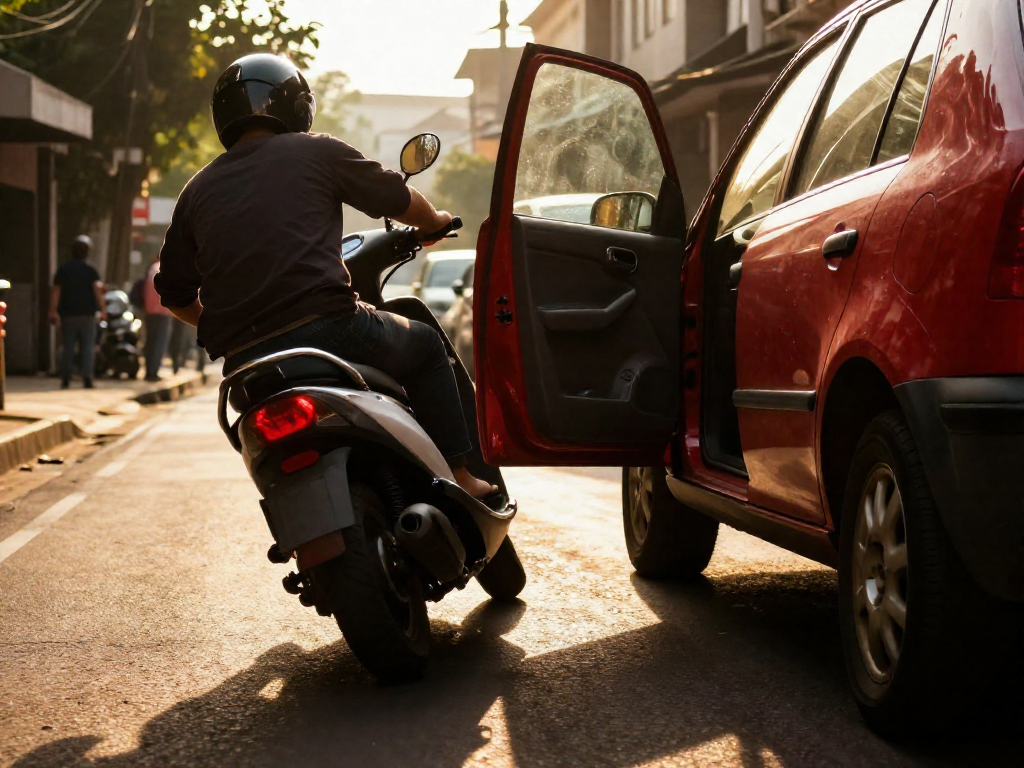
Just a week later, I was filtering along Jalan Ampang when a passenger in a stationary car flung open his door to spit. He wasn’t looking back; he just swung the door wide, inches from my path. I swerved so hard I scraped the kerb on the opposite side and nearly went over the handlebars. The man just stared blankly as I wobbled away. That night, I couldn’t shake the image of what would have happened if I’d been a split second slower. A door into your chest at any speed isn’t a broken mirror—it’s broken bones.
But the incident that truly broke my resolve involved no vehicle at all. Along the narrow, shop-lined stretch of Jalan Sultan, I was splitting past a line of cars stopped at a traffic light. Without warning, a pedestrian squeezed between two bumpers and stepped right into my path. I locked the rear wheel and slid sideways, missing her by a hand’s width. She didn’t even look up from her phone. Pedestrians treat stationary traffic like a solid wall; they never expect something moving between the cars. I used to think I could anticipate such things, but you can’t read minds, and you can’t stop every time.
These weren’t rare events. In stop-and-go KL traffic, they’re the daily reality for anyone who lane splits. The more I rode, the more I understood that risk isn’t additive—it’s multiplicative. One close call per week becomes fifty per year, and it only takes one to change your life. I wasn’t getting luckier; my number was just taking longer to come up. And that’s the gut-wrenching truth: riding skill and alertness can’t overpower the odds when you’re constantly placing yourself in harm’s way.
The Time-Savings Myth
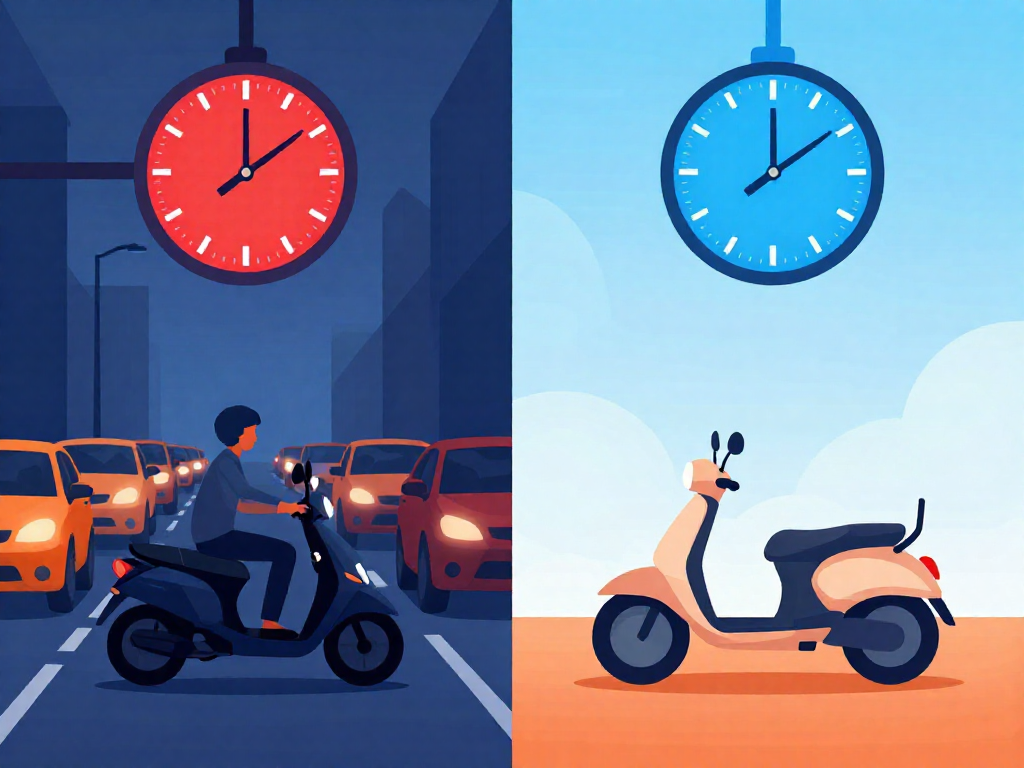
Most riders believe lane splitting slashes commute times, but the actual advantage is surprisingly small. When you time it honestly, slicing through KL gridlock might shave off a minute or two on a 30-minute trip—noticeable only on paper. The brain, however, registers the constant forward motion as massive progress, creating a powerful illusion of speed. That feeling tricks you into thinking you’re saving far more time than you really are.
Anxiety compounds the deception. Threading between lanes demands hyper-vigilance; your muscles tense, your focus narrows. That state of alert makes time crawl, so when you finally stop, the ride feels shorter in memory. It’s a classic psychological twist: the stressful parts fade, leaving you with the impression that the journey flew by. But in the moment, each near-miss stretch seconds into what feels like minutes.
Finally, KL’s ubiquitous traffic lights even the score. You can race ahead through gaps, only to idle at the next red while the car you passed rolls up alongside. Over a route dotted with intersections, the gains evaporate. The perceived head start disappears the moment everyone accelerates from a light together. Coupled with the extra fuel and wear from constant clutch work, lane splitting often saves no real time at all—just a fleeting sense of motion that isn’t worth the risk.
How It Changes Your Riding Brain
Lane splitting doesn’t just put your body in tight spots—it rewires the way your brain judges risk. Constant proximity to moving cars forces a state of hyper-vigilance that, over time, becomes your default riding mode. Suddenly, a gap that once demanded full attention feels routine, and your threshold for what constitutes a close call creeps upward. That normalization is dangerous: you start accepting near misses as part of the commute.
The spillover into open-road riding is subtle but real. After months of threading through KL gridlock, I caught myself following vehicles too closely on the highway and braking later than I used to. The same mental shortcuts that helped me survive lane splitting—quick flicks, assumption of escape routes—bled into situations where they aren’t necessary and actually undermine defensive riding. You end up less cautious precisely when you should be most relaxed.
Cumulative stress compounds the problem. The constant scanning and split-second decisions drain cognitive reserves, leaving you mentally fatigued toward the end of a ride. In that state, your brain defaults to the riskier patterns it learned in traffic, and you’re more likely to misjudge closing speeds or ignore a blind spot. Breaking the habit gave me back a cleaner mental slate: I now ride with deliberate caution everywhere, not just when the lanes get tight.
My New Rules for KL Traffic
I’ve replaced the frantic dart with a handful of rules that keep me calmer — and safer — in KL’s gridlock. Instead of weaving, I now pick a lane and stay in it, even if it means queueing behind cars at the red light. It sounds painfully slow, but the moment I stopped fighting the traffic flow, my whole ride changed.
I lean on Waze’s alternative routes more than ever, sometimes taking longer but quieter kampung roads that bypass the worst jams. On the bike, I focus on breathing steadily and keeping my grip light on the throttle. The biggest shift, though, was accepting that some waits are just part of the commute. That mental surrender erased a layer of stress I didn’t realize I was carrying.
Riding on My Own Terms
For me, trading away peace of mind for a few saved minutes stopped making sense—personal safety simply outweighs any unwritten road rule. Not everyone needs to give it up; if you can lane-split with absolute focus and a clear escape path, that’s your call to make. More than anything, I hope you’ll ride with intention, because the best choice is the one that lets you keep riding tomorrow.